
Why the theme Sports makes a good book
An adventure that suits the child
Sport gives children something concrete to aim for: a goal, a time, a jump that gets a little longer every week. It's about winning, but more often about training, missing, trying again and belonging to a team. A book about sport can show your child in their own kit with their own number, in the sport they actually play or dream of playing. It can also be about losing and still having had fun, which is harder to say than to show.
Football, swimming or something else entirely
The book can be about any sport at all: netball, swimming, riding, gymnastics, athletics, rugby, cricket or climbing. Your child might lose a match but win a new friend on the other team. They might practise a jump that doesn't work, and doesn't work the next time either, and then one Tuesday it does. Your child can look after a new teammate who doesn't know the rules yet, or race the wind on a bike along a gravel track and win by a whisker.
A sports book doesn't need a trophy on the last page. It's often the moments between matches that say the most: the coach trip to the tournament, the chips afterwards, the team singing in the showers.
Shirt numbers, teammates and the coach
Describe your child's real sport and the team colours, the number on the shirt and what the coach always says. Write in a match or tournament you remember, a time your child scored or missed and had to try again. Brothers and sisters cheering from the stands and a parent with a flask in the rain belong here too. If your child doesn't play a sport yet but talks about one constantly, the book can be a first step towards it. Think, too, about what your child finds hardest – losing, waiting on the bench, everyone watching – and write it in. The book can take it seriously without making it bigger than it is.
The match at different ages
Movement and sound go a long way for the littlest ones: kick, bounce, run, hooray. A five-year-old enjoys a match with a clear start and a clear finish. Six- to nine-year-olds get a choice to make, like the goalkeeper question, and teammates who talk to each other. A twelve-year-old can have a deciding moment with real suspense and a few doubts along the way.
Play the match from the book in the garden afterwards. Talk about rules you know: in football only the goalkeeper may handle the ball, and only inside their own penalty area – apart from throw-ins, of course. If you'd like more last-minute finishes, have a look at the idea The Match Decided at the End.
Your child is the hero
You fill in the child's name, age and what they like, and upload a photo. The story about sport is written for your very own child, and the thirteen pictures and the cover are drawn from the photo in the style you choose. Brothers and sisters, parents, grandparents or the pet can come along, up to five characters. If you would like to include something that has happened lately, a trip or a lost tooth, just write it and it is woven in.
From eBook to hardcover book
The eBook is ready a few minutes after payment. Read it, change the text and ask for new pictures until you are happy. Then order it as an A4 hardcover book, printed and sent to your door, or straight to the child as a gift. Do add the audiobook or the coloring pages. Start creating the book or read more about the prices. Would you like to see a finished book before you decide? Browse our example books.
How the story could begin
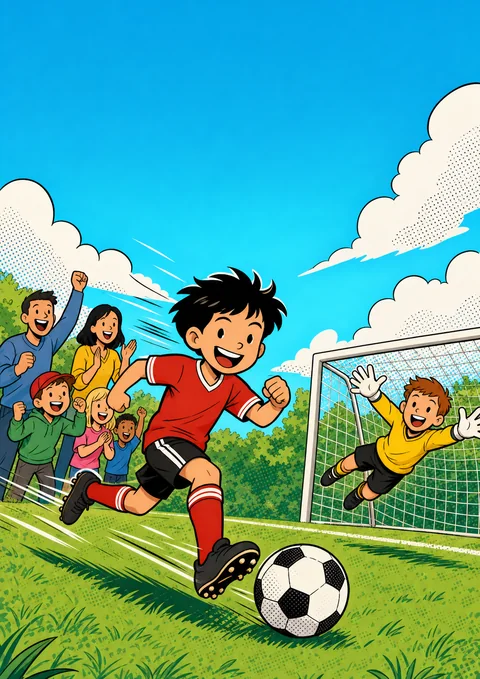
Your match shirt still smells of washing powder. You pull it over your head and twist round to see the number on the back in the mirror. It's your number, the one you got to choose yourself. The changing room is noisy: boots being laced, someone dropping their water bottle, the coach clapping her hands. “Remember,” she says, “we play because it's fun. And we pass to each other.” Out on the pitch the grass is freshly cut and damp, and there's a bit of a breeze. The referee blows the whistle. You run, you get the ball, you lose it, you get it back. At half-time a player from the other team comes over to your bench, red in the face. “Our goalkeeper's twisted her ankle,” they say. “We haven't got anyone else. Could one of you go in our goal?” Everyone looks at you.
 Christmas
 Birthday
 Unicorns
 Dinosaurs
 Pirates
 Space
 Princes and princesses
 Fire department
 Sports
 Mermaids
 Superheroes
 Knights and dragons
 Construction vehicles
 Starting school
 A trip to the farm
 Jungle
 Fairies
 Treasure hunt
 Underwater
 A new baby
 Brushing teeth
 Confidence
 Bedtime story
 The enchanted forest
 Witches and spells
 Giants
 Gnomes
 Wizard school
 Camping
 Time travel
 Haunted house
 Police
 Racing
 Airplanes
 Secret mission
 The zoo
 Dressing up
 Building a tree house
 The amusement park
 A train journey
 A visit to the doctor
 The dentist
 The library
 The beach
 The forest
 Baking
 Music
 Dance
 Ancient Egypt
 The Stone Age
 The Vikings
 In the future
 The Middle Ages
 Candy land
 At the North Pole
 The savannah
 Easter
 Halloween
 Lucia
 Midsummer
 New Year
 Name day
 Eid
 Hanukkah
 Becoming a big brother or sister
 Father's Day
 Mother's Day
 Grandparents
 A new pet
 Moving house
 Sleepovers
 A wedding
 Vacation
 Learning to ride a bike
 Giving up the pacifier
 Potty training
 Tidying up
 Eating well
 Learning to tell the time
 Learning to count
 The alphabet
 Seasons and weather
 Afraid of the dark
 Tantrums
 Feeling homesick
 Being teased
 Jealousy
 Feeling proud
 Handling big feelings
 Funny story
 Olivia
 Muhammad