Why the theme Baking makes a good book
An adventure that suits the child
Baking is one of the few grown-up jobs a child can properly join in with almost from the very start: pouring, stirring, kneading and waiting. Everything can be seen, smelled and changed. Flour and water turn into dough, the dough turns into buns, and the kitchen grows warm. A book about baking lets your child follow that transformation step by step and be the one who knows how it's done. There is something reassuring in it, too. A recipe has an order, and at the end there is something to share with other people.
From mixing bowl to cake stand
A baking book can hold much more than a recipe. The dough might rise so much that it lifts the tea towel and creeps over the edge of the bowl. Your child might bake a secret cake for Dad's birthday and hide it in the fridge behind the milk. It could be an early morning in a bakery, shaping loaves while the town is still asleep. Or a tray of buns big enough for the whole street, so your child gets to knock on every neighbour's door.
Baking also gives you pictures to point at: small hands in the dough, an oven door where something slowly grows, a cloud of flour when the bag hits the floor.
Whose kitchen, whose recipe?
Think about who your child usually bakes with and what you tend to make. Cupcakes, chocolate crispy cakes, mince pies at Christmas or a cake Grandma brought with her from the country she grew up in – it's exactly those details that make the book yours. Tell us which job your child loves most: cracking eggs, brushing on the glaze, scattering the sprinkles. A brother or sister who sneaks a taste of the dough when nobody is looking makes a fun side character. If you have a baking day of your own, like Saturday mornings or the afternoon before a birthday party, the book can take place right then.
Flour, measuring and taste tests
A two-year-old gets smells and movements: stir, stir, pat, pat, warm bun. Pre-schoolers like to see everything happen in the right order, one step per page. In the 6–9 age group something can go wrong – not enough sugar, an oven left on – and your child finds a way to fix it. Older children, from 10 upwards, can have a bake-off with suspense right up to the judges' last mouthful.
Afterwards it's easy to make something from the book for real. Let your child use the measuring jug and see that two halves make a whole. And it's fun to show why the dough grows: yeast is made of tiny living fungi that feed on the sugar and give off bubbles of gas, and it's those bubbles that make the bun light and fluffy.
Your child is the hero
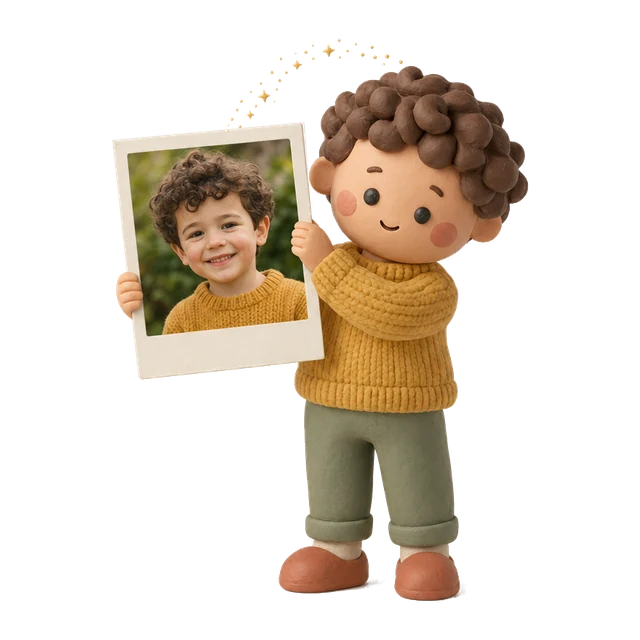
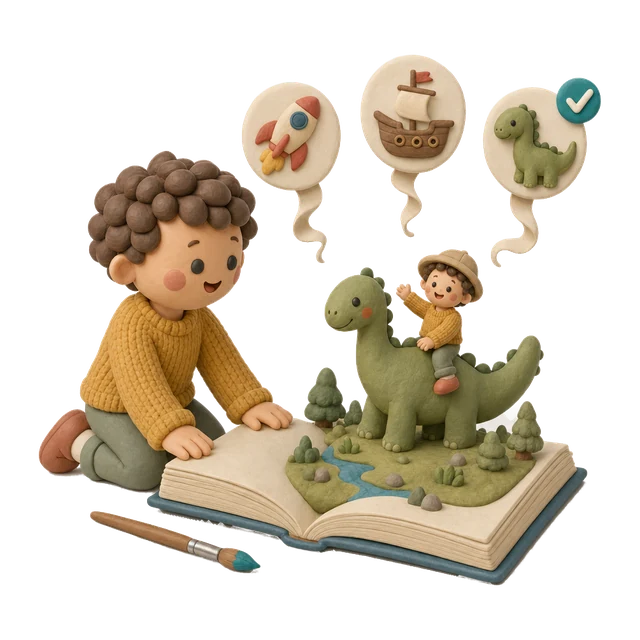
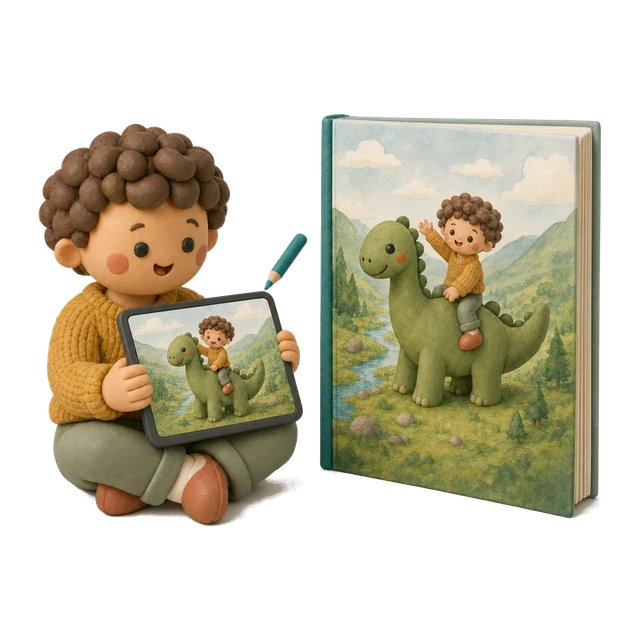
You fill in the child's name, age and what they like, and upload a photo. The story about baking is written for your very own child, and the thirteen pictures and the cover are drawn from the photo in the style you choose. Brothers and sisters, parents, grandparents or the pet can come along, up to five characters. If you would like to include something that has happened lately, a trip or a lost tooth, just write it and it is woven in.
From eBook to hardcover book
The eBook is ready a few minutes after payment. Read it, change the text and ask for new pictures until you are happy. Then order it as an A4 hardcover book, printed and sent to your door, or straight to the child as a gift. Do add the audiobook or the coloring pages. Start creating the book or read more about the prices. Would you like to see a finished book before you decide? Browse our example books.
How the story could begin
The apron is far too big, so Grandma folds it over twice and ties a bow at your back. Everything is laid out on the worktop: a mixing bowl, a whisk, eggs in a box and a jar of cinnamon that you get to sniff first. “Today you're the baker,” says Grandma. “I'm only the helper.” You crack the first egg. A bit of shell falls in too, but you fish it out with a spoon. The butter is soft and the sugar crunches as you stir. Then you open the tin on the shelf to get the cutters out – and there, between the gingerbread men, lies a folded note in curly handwriting. “To whoever bakes in this kitchen,” it says. “The secret recipe is real. But only the one who finds all three ingredients may read it.”
 Christmas
 Birthday
 Unicorns
 Dinosaurs
 Pirates
 Space
 Princes and princesses
 Fire department
 Sports
 Mermaids
 Superheroes
 Knights and dragons
 Construction vehicles
 Starting school
 A trip to the farm
 Jungle
 Fairies
 Treasure hunt
 Underwater
 A new baby
 Brushing teeth
 Confidence
 Bedtime story
 The enchanted forest
 Witches and spells
 Giants
 Gnomes
 Wizard school
 Camping
 Time travel
 Haunted house
 Police
 Racing
 Airplanes
 Secret mission
 The zoo
 Dressing up
 Building a tree house
 The amusement park
 A train journey
 A visit to the doctor
 The dentist
 The library
 The beach
 The forest
 Baking
 Music
 Dance
 Ancient Egypt
 The Stone Age
 The Vikings
 In the future
 The Middle Ages
 Candy land
 At the North Pole
 The savannah
 Easter
 Halloween
 Lucia
 Midsummer
 New Year
 Name day
 Eid
 Hanukkah
 Becoming a big brother or sister
 Father's Day
 Mother's Day
 Grandparents
 A new pet
 Moving house
 Sleepovers
 A wedding
 Vacation
 Learning to ride a bike
 Giving up the pacifier
 Potty training
 Tidying up
 Eating well
 Learning to tell the time
 Learning to count
 The alphabet
 Seasons and weather
 Afraid of the dark
 Tantrums
 Feeling homesick
 Being teased
 Jealousy
 Feeling proud
 Handling big feelings
 Funny story
 Olivia
 Muhammad